You’ve received a summons or filed a case. The first court date is approaching. You’re nervous, maybe scared. You’ve seen court scenes in movies, but real court is nothing like that.
“What will actually happen? What should I do? What should I say? What if I make a mistake?”
Let me walk you through exactly what happens on the first date of hearing, step by step, so you’re prepared and confident.
Understanding “First Date of Hearing”
First, let’s clarify what this means:
If you’re the DEFENDANT/ACCUSED (case filed against you):
- First date is usually the date mentioned in the summons
- This is when court expects you to appear
- Purpose: Respond to allegations against you
If you’re the PLAINTIFF/COMPLAINANT (you filed the case):
- First date is when court schedules first hearing after accepting your case
- You’ve already filed; now formal proceedings begin
Important: “First date” doesn’t mean trial starts. It’s just the beginning of the legal process.
Before the First Date: Preparation
What You Should Do Before Going to Court
1. Hire a Lawyer (Strongly Recommended)
Unless it’s:
- Very small claims court
- Consumer forum for small amount
- Lok Adalat
You should have a lawyer.
Why?
- They understand court procedures
- They know the judge’s style
- They can anticipate issues
- They can handle technical objections
- You might say something wrong unknowingly
When to hire: At least 5-7 days before first date so lawyer can prepare.
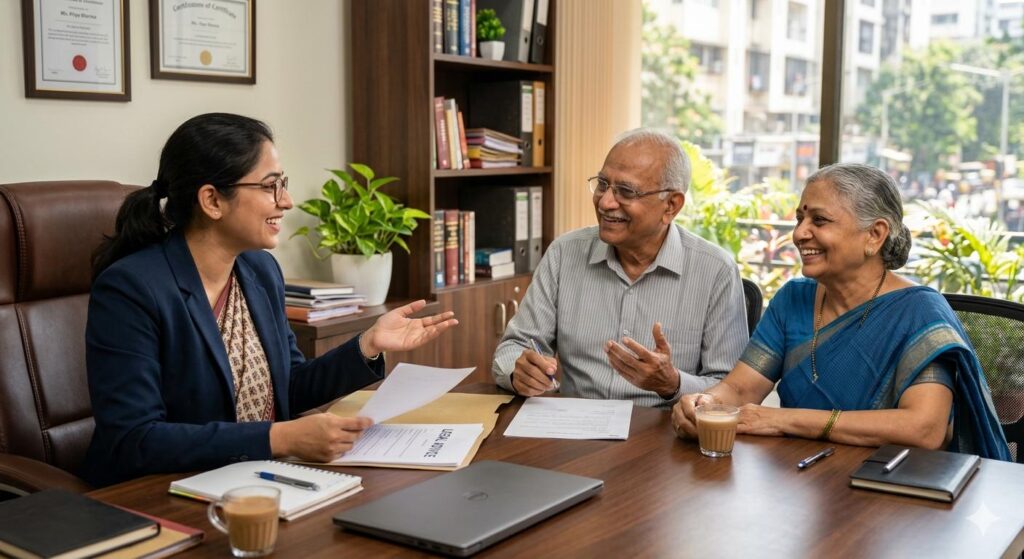
2. Brief Your Lawyer Completely
Give your lawyer:
- Copy of summons/plaint/complaint
- All relevant documents
- Timeline of events
- Names of witnesses
- Your version of events
Be honest: Don’t hide facts. Lawyers need truth to defend you effectively.
3. Carry Essential Documents
- Original summons/notice
- Vakalatnama (if lawyer is appearing for you)
- All relevant documents (originals + photocopies)
- ID proof
- Previous court orders (if any)
4. Dress Appropriately
For men:
- Formal shirt and trousers (or traditional wear)
- Avoid shorts, sleeveless shirts, casual jeans
- Lawyers typically wear white shirt, black coat, black trousers
For women:
- Formal or traditional attire
- Avoid overly casual or revealing clothing
- Saree, salwar kameez, or formal western wear all fine
Why it matters: Court is a place of dignity. Appropriate dress shows respect.
5. Plan to Reach Early
- Reach at least 30 minutes before scheduled time
- Courts can be crowded; finding the right courtroom takes time
- Gives you time to meet your lawyer, discuss strategy
The Court Environment: What to Expect
Physical Setting
Different courts, different settings:
District Court/Sessions Court:
- Multiple courtrooms in one building
- Each courtroom has:
- Judge’s elevated platform/bench
- Lawyers’ area in front
- Public seating at back
- Witness box (for witnesses to testify)
Magistrate Court:
- Similar but smaller
- Often more crowded
High Court:
- More formal
- Larger courtrooms
- More staff
What you’ll see:
- Judge in black coat (and sometimes band)
- Lawyers in black coats
- Court staff (reader, clerk)
- Other cases being heard
- People waiting
Sounds:
- Judge calling out case numbers
- Lawyers arguing
- Paper shuffling
- People talking (often noisy)
Reality check: Indian courts are usually crowded and noisy, especially lower courts. Don’t expect the pin-drop silence you see in movies.
Court Timings
Typical schedule:
- Morning session: 10:30 AM – 1:30 PM
- Afternoon session: 2:00 PM – 5:00 PM (not all courts have afternoon sessions)
Reality: Courts often start late and run late. Your 11 AM case might actually be called at 12 PM or later.
Court Language
Official language: Hindi and English (varies by state)
Reality: In lower courts, often local language is used informally, but official proceedings are in Hindi/English.
If you don’t understand: You can request translation/explanation in language you understand. This is your right.
Step-by-Step: What Actually Happens
Step 1: Finding the Right Courtroom
Check the notice board:
- Courts have boards listing cases and courtroom numbers
- Find your case number and courtroom
Ask court staff: If you can’t find it, ask clerks or court staff (be polite).
Your lawyer will know: If you have a lawyer, they’ll guide you to the right courtroom.
Step 2: Waiting for Your Case to Be Called
Inside the courtroom:
- Sit in the public seating area
- Your lawyer will be in the lawyers’ area
- Wait for your case number to be called
How cases are called:
- Judge has a list (board/cause list)
- Cases are called in order (roughly)
- Sometimes urgent matters are taken up first
- Your case number and parties’ names will be called out
Example: “Case No. 123/2024, Ramesh Kumar versus Sunil Sharma”
Your role: Listen carefully. When your case is called, your lawyer will step forward. If you’re alone, you step forward.
Reality: There might be 50-100 cases listed on one day. Your case might be called immediately or after hours of waiting. Bring patience.
Step 3: Case Is Called – Appearance
What happens:
Judge: “Case no. 123/2024. Ramesh Kumar versus Sunil Sharma.”
Your lawyer: “Present, My Lord/Your Honor” (stands up)
Opposite party’s lawyer: “Present, My Lord” (stands up)
Or if no lawyer: You say “Present, Your Honor” and step forward.
Judge notes: Both parties are present.
Step 4: Purpose of First Hearing (Varies by Type)
A. In Civil Cases (You’re Defendant)
Purpose: Verify service of summons and give time to file written statement.
What happens:
Judge: “Have you received the summons?”
Your lawyer: “Yes, My Lord. I have instructions. I seek time to file written statement.”
Judge: “How much time?”
Your lawyer: “30 days, My Lord.” (standard request)
Judge: “Granted. File written statement within 30 days. Next date [mentions date].”
Your lawyer: “As your Lordship pleases.”
That’s it! Hearing over in 2-3 minutes.
What just happened:
- Court verified you received summons (you appeared, so obviously you did)
- Gave you 30 days to file your written response
- Fixed next date
Note: If you already filed written statement before first date (smart move), your lawyer will mention it, and case proceeds to next stage.
B. In Civil Cases (You’re Plaintiff)
Purpose: Court checks if summons was served on defendant.
What happens:
Judge: “Summons served?”
Your lawyer: “Yes, My Lord. Process server’s report is on record. Defendant has appeared through counsel.”
Judge: “Time for written statement?”
Defendant’s lawyer: “30 days, My Lord.”
Judge: “Granted. Next date [date].”
Your role: Minimal on first date. You’ve already filed; now defendant gets time to respond.
C. In Criminal Cases (Trial Cases)
Purpose: Verify your presence, may read charges, set timelines.
What happens:
Judge: “Accused present?”
Your lawyer: “Present, My Lord.”
Judge might:
- Read charges to you (formally state what you’re accused of)
- Ask if you need bail (if you’re in custody)
- Grant time to file documents
- Fix date for charge-framing or next hearing
Judge: “How do you plead – guilty or not guilty?”
Your lawyer: “Not guilty, My Lord.”
Judge: “Matter for charge-framing. Next date [date].”
Important: First date is usually just procedural. Actual trial comes much later.
D. In Criminal Cases (Bail Applications)
If it’s your bail hearing:
Much more substantial. This isn’t just procedural; arguments happen.
Prosecution lawyer: Argues against bail (you’re a flight risk, might tamper with evidence, serious crime, etc.)
Your lawyer: Argues for bail (you’re innocent, you’ll cooperate, you have roots in community, no prior criminal record, etc.)
Judge: Hears both sides, might ask questions, then:
- Grants bail (with conditions)
- Rejects bail
- Reserves order (will decide later)
If bail granted: You sign bond, provide sureties, get released.
E. In Consumer Forums/Lok Adalats
More informal:
Consumer Forum:
- Both parties introduce themselves
- Brief overview of complaint
- Respondent gets time to file reply
- Date for evidence/settlement discussion
Lok Adalat:
- Panel explains process
- Urges settlement
- Parties discuss (might settle same day!)
Step 5: Court Orders and Next Date
After brief hearing:
Judge passes order:
- Time granted for filing documents
- Next date fixed
- Any other directions
Court clerk notes everything.
Judge: “Next date [date – usually 2-6 weeks later].”
Your lawyer: “As your Lordship pleases.” (standard response showing respect)
Hearing ends.
Step 6: Collecting Order Copy
After hearing:
- Court order is typed/written
- Collect certified copy from court office (might take few days)
- Or your lawyer collects it
Why you need it: To know exact directions, to file your documents within time, to know next date.
Step 7: Outside Court – Debrief with Lawyer
After hearing, talk to your lawyer:
- What happened?
- What do we do next?
- What documents to prepare?
- When’s next date?
- What to expect next time?
This is important. Don’t just leave without understanding next steps.
Common Scenarios on First Date
Scenario 1: You Don’t Appear
If defendant doesn’t appear:
Judge: “Defendant not present. Summons served?”
If summons was served: Judge might:
- Issue second summons (giving one more chance)
- Proceed ex-parte (case continues without you)
If summons wasn’t served: Judge orders fresh service.
WARNING: Not appearing is bad. Shows disrespect to court. Can lead to ex-parte decree against you.
Scenario 2: Opposite Party Doesn’t Appear
If plaintiff doesn’t appear:
- Judge might dismiss case for non-prosecution
- Or adjourn (give another date)
If defendant doesn’t appear (civil):
- Proceed ex-parte after proper service
If accused doesn’t appear (criminal):
- Issue warrant (in serious cases)
- Issue summons/notice (in less serious cases)
Scenario 3: Both Parties Want to Settle
Beautiful scenario!
Your lawyer: “My Lord, parties have settled the matter amicably. We seek to place settlement on record.”
Judge: “Very good. File settlement agreement. I’ll pass consent decree/order.”
Case ends on first date itself! (This happens more often than you think)
Scenario 4: Plaintiff Wants to Withdraw Case
Plaintiff’s lawyer: “My Lord, plaintiff seeks to withdraw the case. We file withdrawal application.”
Judge: “Any objection?” (asks defendant)
If no objection: “Application allowed. Case dismissed.”
Case ends!
Scenario 5: You Want More Time
Your lawyer: “My Lord, I need 60 days instead of 30 for written statement due to [reason].”
Judge might:
- Grant extension
- Grant partial extension (45 days)
- Refuse and stick to 30 days
Be reasonable. Don’t ask for excessive time without valid reason.
Scenario 6: Preliminary Objections
Sometimes on first date itself:
Defendant’s lawyer: “My Lord, I have preliminary objections. The suit is barred by limitation / This court has no jurisdiction / Plaintiff has no cause of action.”
Judge: “File application with written statement. I’ll hear it.”
Or sometimes: “Argue it now.”
Then brief arguments happen, and judge decides or reserves order.
What You Should and Shouldn’t Do
DO:
✅ Reach early – Courts are unpredictable
✅ Dress formally – Show respect
✅ Bring all documents – Originals and copies
✅ Listen carefully – When your case is called
✅ Stand when your case is called – Show respect to court
✅ Be patient – Your case might be called late
✅ Follow your lawyer’s instructions – They know what they’re doing
✅ Be respectful to judge – Address as “Your Honor” or “My Lord”
✅ Be honest – If judge asks you something directly
✅ Take notes – Of what judge orders, next date, etc.
✅ Stay calm – Even if things don’t go as expected
DON’T:
❌ Don’t be late – Can lead to ex-parte orders
❌ Don’t interrupt the judge – Wait for your turn
❌ Don’t argue directly with opposite party – Communicate through lawyers
❌ Don’t use phone in courtroom – It’s prohibited in most courts
❌ Don’t eat/drink in courtroom – Disrespectful
❌ Don’t talk loudly – Disturbs proceedings
❌ Don’t sit in lawyers’ area – Unless you’re representing yourself
❌ Don’t take photos/videos – Strictly prohibited
❌ Don’t get emotional or aggressive – Maintain composure
❌ Don’t speak unless asked – Your lawyer will handle it
If You’re Representing Yourself (Without Lawyer)
Possible in:
- Small claims
- Consumer forums
- Simple matters
What to do:
1. Research basic procedure:
- Understand what documents to file
- Know the format
- Read similar cases
2. Speak respectfully:
- Address judge as “Your Honor” or “My Lord/Milord”
- Be humble, not argumentative
- Admit if you don’t understand something
3. Be concise:
- Don’t ramble
- State facts clearly
- Answer questions directly
4. Request assistance:
- “Your Honor, I’m not familiar with procedure. Could you guide me?”
- Most judges will help genuinely confused parties
Example: In Anita Kushwaha v. Pushap Sudan (2016), Supreme Court emphasized that self-representation is a right and courts should assist such parties reasonably.
But honestly: For anything serious (above ₹1 lakh, or criminal case), get a lawyer. False economy to save on lawyer fees and lose the case.
After the First Date: Next Steps
Based on what happened:
If You Got Time to File Documents:
1. Prepare written statement/reply:
- Work with your lawyer
- Address each allegation specifically
- Raise all defenses
- Include all evidence
2. File within deadline:
- Usually 30 days
- Courts are strict about deadlines
- Request extension early if needed
3. Serve copy on opposite party:
- Through court or directly
- Keep proof of service
If Court Referred to Mediation:
1. Attend mediation sessions:
- Be open-minded
- Try to settle
- But don’t agree to unfair terms under pressure
2. If settlement reached:
- Get it in writing
- File in court
- Court passes consent decree
3. If mediation fails:
- Case comes back to court
- Trial proceeds
If Next Date for Regular Hearing:
1. Prepare for next stage:
- Document filing
- Evidence presentation
- Witness preparation
2. Attend all dates:
- Mark in calendar
- Set reminders
- Don’t miss dates
Understanding Time Frames
Realistic expectations:
First date → Final judgment:
- Civil cases: 2-5 years typically (can be longer)
- Criminal trials: 1-3 years typically
- Consumer forums: 1-2 years (faster than civil courts)
- Arbitration: 6 months – 2 years
Number of hearings:
- Varies widely
- Could be 10-50+ hearings
- Hearings often get adjourned (postponed)
Why so many dates:
- Lawyers not available
- Judges on leave
- Paperwork incomplete
- Witnesses don’t appear
- Court holidays
- Systemic delays
In State of Punjab v. Ram Singh (1992), Supreme Court noted the problem of repeated adjournments and delays, but this remains a reality in Indian courts.
FAQs
What if I’m too nervous to speak in court?
That’s exactly why you have a lawyer! Your lawyer does 99% of the talking. You rarely need to speak on first date. Even later, usually only when giving evidence.
What if judge asks me something directly?
Answer respectfully and truthfully:
- Stand up
- Address as “Your Honor”
- Give brief, direct answer
- Don’t elaborate unless asked
Can I bring family members?
Yes! Courts are public (with rare exceptions). Family can sit in public area for moral support.
What if I don’t understand the language being used?
You have right to proceedings in a language you understand. Tell the judge: “Your Honor, I don’t understand [Hindi/English]. May I request proceedings in [language]?”
Court should provide translator or conduct proceedings in language you understand.
Can I record the proceedings?
Generally NO. Recording (audio/video) is prohibited in most courts without specific permission. You can take written notes.
What if my lawyer doesn’t appear?
Request adjournment: “Your Honor, my lawyer is not available today. May I request adjournment?”
Judge might grant it (with or without costs) or might proceed if matter is simple.
What if I need to go to bathroom during proceedings?
Wait for a break or when your case is not being heard. Don’t get up when judge is speaking or when your case is going on.
What happens if I faint or have medical emergency?
Court staff will help. Medical facilities available in court complex. Your case will be adjourned.
Is there a dress code?
Not strictly enforced for parties, but:
- No shorts, sleeveless, slippers (for men)
- No overly casual or revealing clothing (for women)
- Formal/traditional attire preferred
Lawyers have strict dress code (white shirt, black coat, black trousers/saree).
Can opposite party talk to me directly in court?
They might try, but discouraged. All communication should be through lawyers or before judge. Don’t engage in arguments with opposite party.
The Psychological Aspect
It’s normal to feel:
- Nervous
- Intimidated
- Confused
- Overwhelmed
Remember:
- Judges are humans, most are patient with first-timers
- Your lawyer is there to guide you
- First date is just beginning; nothing dramatic happens
- Thousands of people go through this daily
- It gets less scary with each subsequent appearance
Example: Many people report that after first court appearance, subsequent ones feel much easier because they know what to expect.
The Bottom Line
First date of hearing is mostly procedural. It’s not dramatic like movies. Here’s what typically happens:
Summary:
- ⏰ You reach court early, find your courtroom
- ⏳ You wait for your case to be called (might take 30 mins to 3 hours)
- 📢 Case is called, lawyers/parties present themselves
- 🗣️ Brief submissions (asking for time to file documents)
- 📝 Judge passes order (grants time, fixes next date)
- ✅ Hearing ends (usually 2-5 minutes for first date)
- 📋 Collect copy of order, discuss next steps with lawyer
Total time in court: 2-4 hours (mostly waiting) Time before judge: 2-5 minutes (first date)
Key takeaways: ✅ Be prepared, reach early, dress appropriately ✅ Have a lawyer for anything serious ✅ Be patient – courts are crowded ✅ Be respectful – to judge, staff, opposite party ✅ Be honest – don’t lie to your lawyer or court ✅ Understand next steps – what to do before next date ✅ This is a marathon, not a sprint – prepare for long process
As the Supreme Court noted in Hussainara Khatoon v. State of Bihar (1979), access to justice is a fundamental right, but it requires patience and participation in the judicial process.
Your first court appearance is the beginning of your journey through the justice system. Come prepared, stay patient, and trust the process.
And remember: Everyone in that courtroom was a first-timer once. You’re not alone. You’ll get through this.
If you are facing a legal issue like a civil dispute, it is always better to consult experts. Visit our website 👉 https://www.lexfiedgo.in/ to get professional legal guidance. Good luck!