
Lending money to a friend or relative feels like the right thing to do at the time. You trust them. You care about them. You don’t want to seem like you’re making a big deal out of it. But weeks become months, months become years, and the person who once desperately needed your help has gone strangely quiet on the topic of repayment.
This is one of the most emotionally complicated legal situations a person can face — because the person who owes you money is also someone you may still love and want to maintain a relationship with. The good news is that Indian law gives you clear tools to recover your money, and you do not have to choose between your relationship and your rights. But acting thoughtfully — and early — makes all the difference.
Let’s walk through everything you need to know.
Step 1 — Try to Resolve It Personally First
Before taking any formal legal step, make one sincere, clear attempt to resolve the matter directly. Arrange a meeting or send a written message — via WhatsApp, email, or letter — stating clearly that you expect repayment of the specific amount, and ask for a clear date by which they will pay.
This is important for two reasons. First, it genuinely gives the other person a chance to do the right thing without the relationship being destroyed. Second, if the matter ever goes to court, this communication becomes part of your documentary trail — showing that you made a fair, reasonable attempt before escalating.
Keep this communication respectful and factual. Avoid threats or emotional language. Something as simple as: “I wanted to follow up on the Rs. 50,000 I lent you on [date]. I would appreciate if you could let me know when you plan to return it” is ideal. The more composed and documented your communication, the stronger your eventual legal position.
Step 2 — Gather All Your Evidence
Before any legal action, organise every piece of proof you have. Courts in India work on evidence — not just your word against theirs. The stronger your documentary trail, the stronger your case.
Strong evidence includes: bank transfer records (IMPS, NEFT, UPI screenshots showing the transfer to their account), WhatsApp messages or emails in which the person acknowledges they owe you money or promises to repay, any written note or document signed by the borrower, repayment history (if they paid one or two installments and then stopped, those prior payments are evidence the loan existed), and witness testimony from anyone who was present when the money was lent.
Even if you have nothing formal, bank records showing you transferred money to this person are already a starting point. A competent lawyer can build a case from this, especially if the borrower’s own messages or behaviour confirm the loan.
Step 3 — Send a Legal Notice
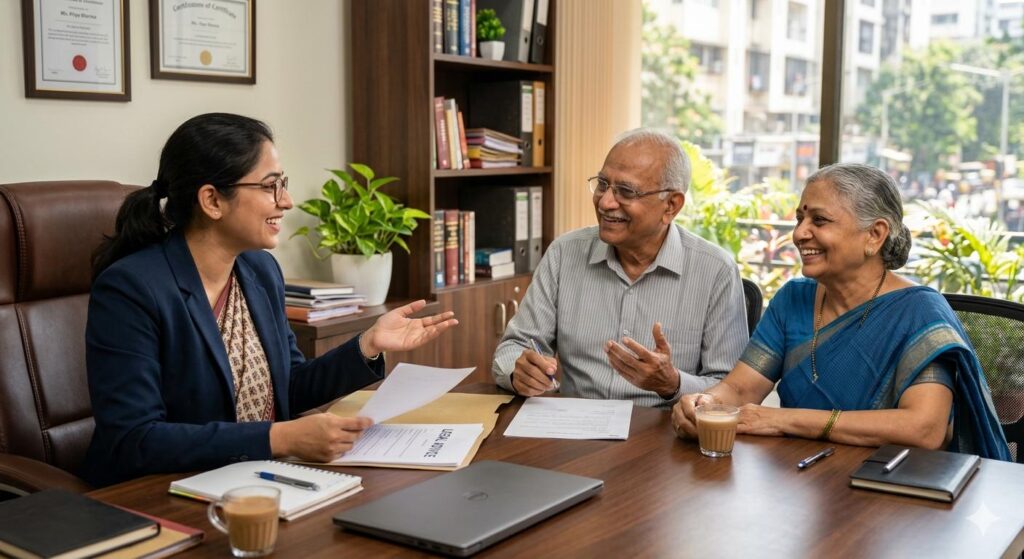
The most important and effective first formal step is to send a legal notice through a lawyer. A legal notice is a formal, written demand that puts the borrower on official record that you are making a legal claim for your money and that you will take legal action if they do not pay within a specified time (usually 15 to 30 days).
Many friends and relatives who have been comfortably ignoring your polite requests pay up immediately when they receive a legal notice. The combination of a lawyer’s letterhead, specific legal language, and a clear deadline shifts the tone of the matter significantly. It shows the other person that you are serious and that the matter is no longer just personal.
A legal notice also starts the formal documentary trail if the matter proceeds to court. It establishes the date from which the person was formally informed of your legal claim.
Step 4 — Choose the Right Legal Route
If the legal notice doesn’t work, you have several options depending on your situation.
Civil Suit for Recovery of Money
This is the standard route. You file a case in the civil court having jurisdiction, present your evidence, and ask the court for a decree — a formal court order directing the person to repay you. Under the Code of Civil Procedure, 1908 (CPC), civil suits for recovery of money must generally be filed within 3 years from when the payment was due. Do not delay.
Summary Suit Under Order 37 CPC
If you have strong documentary evidence — a signed promissory note, a written acknowledgment of the debt, or a written agreement — you can file a much faster Summary Suit. In this type of case, the defendant cannot simply walk in and contest the matter freely. They need the court’s special permission to argue their defence, which significantly speeds up the process in your favour.
Cheque Bounce Case Under Section 138 of the NI Act
If the person gave you a cheque toward repayment and that cheque bounced, this is one of the most powerful options available to you. A bounced cheque is not just a civil matter — it is a criminal offence under Section 138 of the Negotiable Instruments Act, 1881, punishable with up to 2 years in prison or a fine of double the cheque amount. You must send a legal notice within 30 days of the bounce, and if they don’t pay within 15 days of that notice, you can file a criminal complaint. The threat of criminal liability in what was a personal loan dispute is often the fastest route to recovery.
Lok Adalat
If both of you are willing to discuss and settle, a Lok Adalat is an excellent free option. A Lok Adalat is a forum where disputes are resolved by mutual agreement facilitated by a panel. The settlement is final and binding like a court decree. This is particularly useful for maintaining whatever remains of the personal relationship while still formally resolving the debt.
Real Court Cases That Explain the Law
Case 1 — Babulal Vardharji Gurjar v. Veer Gurjar Aluminium Industries (2020) 15 SCC 1
What happened: A creditor filed a money recovery suit against a debtor. The question arose about the nature of evidence required to prove the existence of an oral loan transaction — one where no formal written agreement existed. The case involved significant amounts and the debtor disputed the loan entirely.
What the Supreme Court decided: The Court reaffirmed the principle that even in the absence of a formal written agreement, a loan or money transaction can be proved through circumstantial evidence, conduct of parties, banking records, and any written communication between the parties. The burden of proof lies on the person claiming the money, but that burden can be discharged through all available forms of evidence — not just formal documents.
Why it matters for you: Even if you lent money to a friend with nothing more than a bank transfer and a casual conversation, you can still recover it. Banking records, WhatsApp messages, and the borrower’s own conduct (like making partial payments) can together prove the loan existed. A written agreement helps enormously, but its absence is not the end of your case.
Case 2 — Neelkanth v. Suresh Kumar, AIR 2001 Delhi 421
What happened: Neelkanth had lent a sum of money to Suresh Kumar, a personal acquaintance, without any formal written agreement. When Suresh Kumar refused to repay, Neelkanth filed a civil suit relying primarily on evidence of the bank transfer, the borrower’s verbal acknowledgments before witnesses, and one subsequent written message.
What the Delhi High Court decided: The Court held that the existence of a loan between friends and relatives can be established through a combination of evidence — bank records showing the transfer, witness testimony, and even letters or messages where the borrower has acknowledged the debt or promised to repay. The Court awarded recovery with interest.
Why it matters for you: This case from the Delhi High Court directly addresses the most common scenario — a personal loan between friends or relatives without a formal agreement. The Court accepted circumstantial and combined evidence to prove the loan, which is exactly the situation most people find themselves in.
Case 3 — Rangappa v. Sri Mohan (2010) 11 SCC 441
What happened: This case involved a cheque given in partial repayment of a personal loan. The cheque bounced. The person who gave the cheque claimed it was not for any real debt but had been given as a “blank cheque” for security purposes. He argued there was no actual underlying loan.
What the Supreme Court decided: The Court firmly held that once a cheque is presented and the signature is admitted, there is a strong legal presumption under Section 139 of the Negotiable Instruments Act that the cheque was issued in discharge of a real, legally enforceable debt. The person who gave the cheque carries the burden of disproving this presumption — and a vague claim that it was a “blank cheque” or “security cheque” is not enough to discharge that burden without concrete evidence.
Why it matters for you: If a friend or relative gave you a cheque toward repayment of your loan and it bounced, you do not need to fight hard to prove the loan existed. The legal presumption works in your favour. Their own cheque is evidence of the debt. This is why getting a cheque (or post-dated cheques) from a borrower is such a practical protective step when lending money.
Case 4 — V.C. Rangadurai v. D. Gopalan, AIR 1979 SC 281
What happened: A lender filed a suit for recovery of a loan given to a person with whom they had a personal relationship. The borrower claimed the amount was a gift, not a loan. There was no formal written agreement. The case turned entirely on whether the surrounding circumstances and evidence supported the lender’s version.
What the Supreme Court decided: The Court held that when a sum of money is given by one person to another, the presumption in law is not that it was a gift — it is that it was a loan, unless there is clear evidence to the contrary. The burden lies on the person receiving the money to prove that it was given as a gift. This is a very favourable presumption for lenders.
Why it matters for you: When a friend or relative claims your money was a “gift” rather than a loan — a common defence tactic — the law actually presumes against them. They have to prove it was a gift. You simply need to show the transfer happened and that there was an expectation of repayment.
Real-Life Examples to Understand Better
Example 1 — The Friend Who Always Has an Excuse
Rahul lent Rs. 75,000 to his college friend Aakash via bank transfer in 2022. Aakash promised to repay within 6 months. Two years later, Aakash gives new excuses every time Rahul asks. Rahul has the bank transfer records and a WhatsApp conversation where Aakash wrote “I’ll definitely return it by Diwali.” Rahul sends a legal notice. Aakash, suddenly realising the legal seriousness, repays within 3 weeks to avoid court proceedings.
Example 2 — The Relative Who Denies the Loan
Sunita lent Rs. 2 lakh to her cousin Priya for her daughter’s wedding in 2021. Priya now denies the loan ever happened and claims it was a gift. Sunita has a bank transfer receipt and two WhatsApp messages in which Priya wrote “I’ll return it as soon as possible, promise.” Sunita files a civil suit. Based on the bank transfer and Priya’s own messages, the court passes a decree in Sunita’s favour.
Example 3 — The Bounced Cheque from a Brother-in-Law
Vikram lent Rs. 1 lakh to his brother-in-law Deepak and received a cheque in repayment. The cheque bounced due to insufficient funds. Vikram sends a legal notice within 30 days. Deepak doesn’t pay within 15 days. Vikram files a Section 138 NI Act complaint. Faced with criminal proceedings, Deepak pays the full amount before the next hearing date to avoid being prosecuted.
Example 4 — The Long-Term Loan That Became a Dispute
Meena lent Rs. 3 lakh to her close friend Seema in 2019 in instalments, through multiple bank transfers. Seema repaid Rs. 50,000 in two tranches and then stopped. Meena files a civil recovery suit with her bank transfer records and Seema’s own payment records as evidence. The court finds the loan proved and awards Meena the balance amount with interest from the date of the suit.
Step-by-Step Action Plan
Step 1 — Try to resolve it personally. One clear, respectful written message giving the person a fair chance to pay.
Step 2 — Gather all evidence. Bank transfers, WhatsApp messages, emails, cheques, witness names, repayment records.
Step 3 — Send a legal notice. Through a lawyer, within 3 years of the payment becoming due (and within 30 days of a cheque bounce).
Step 4 — Choose the right legal route. Civil suit for most cases. Summary Suit if you have a written document. Section 138 complaint if a cheque bounced. Lok Adalat if both sides are willing to settle.
Step 5 — File within the limitation period. You generally have 3 years from when the repayment was due to file a civil suit.
Step 6 — Execute the decree. If you win and they still don’t pay, apply for execution proceedings — the court can attach their bank account or property.
Frequently Asked Questions (FAQs)
Q1. Can I recover money lent to a friend without any written agreement?
Yes. As confirmed in cases like Neelkanth v. Suresh Kumar and Babulal Vardharji Gurjar v. Veer Gurjar Aluminium, loans between friends and relatives can be proven through bank transfer records, WhatsApp acknowledgments, witness testimony, and the borrower’s prior conduct (like making partial payments). A written agreement makes the case stronger and faster — but it is not a mandatory requirement.
Q2. What if the person says the money was a gift, not a loan?
Indian courts presume that money paid from one person to another is a loan — not a gift — unless the person receiving it can clearly prove it was given as a gift, as established in V.C. Rangadurai v. D. Gopalan (1979). So if a friend or relative claims your money was a gift, the burden of proving that falls on them.
Q3. How long do I have to file a case?
Under the Limitation Act, 1963, you generally have 3 years from the date the repayment was due. If the borrower sent a written acknowledgment of the debt at any point — even a WhatsApp message saying “I’ll pay you back” — that acknowledgment can restart the limitation period from the date it was sent, under Section 18 of the Limitation Act.
Q4. Can WhatsApp messages be used as evidence in court?
Yes. WhatsApp messages are admissible as electronic evidence under the Bharatiya Sakshya Adhiniyam, 2023 (BSA). However, to be admitted properly, they must be accompanied by a Section 63 certificate (previously Section 65B under the old Indian Evidence Act) confirming their authenticity. Your lawyer will guide you through this process. Screenshots where the borrower acknowledges the debt or promises to repay have been accepted by courts in multiple cases.
Q5. Will filing a case destroy the relationship completely?
This is a real concern and an honest one. However, it is also worth noting that in most personal loan disputes, the relationship has already been significantly damaged by the non-repayment. Filing a legal case does not have to mean a public court battle — a Lok Adalat settlement or mediation can resolve the matter formally while giving both sides an opportunity to settle with dignity. And once the money is returned, many relationships have recovered. Non-action, on the other hand, often leads to resentment that never heals.
Q6. Can I recover interest on the loan?
Yes. If you had an agreement about interest — written or evidenced through your communications — you can claim the agreed interest amount. Even if there was no agreement, courts can and do award simple interest on the principal amount from the date of the suit as reasonable compensation for the delay.
Q7. What if the borrower is unemployed or has no assets?
This is one of the most practical concerns. Even if you get a decree from the court, recovering money from someone who genuinely has no assets is difficult. Courts can order disclosure of assets, attach future earnings, and in some cases order civil imprisonment — but these are last resorts and practically challenging. This is why acting early (before the person becomes insolvent) is so important.
Q8. Can I file a criminal case for non-repayment of a personal loan?
Simply failing to repay a personal loan is generally a civil matter — not a criminal one. However, if you can show that the person borrowed money with a fraudulent intention from the very beginning — with no intention of ever repaying you — it may qualify as cheating under Section 318 of the Bharatiya Nyaya Sanhita (BNS), 2023. This is a higher bar to meet and requires clear evidence of fraudulent intent.
Quick Summary
Non-repayment of a personal loan by a friend or relative is both legally actionable and emotionally painful. The first step is to try to resolve it personally with a clear, written message. If that fails, gather all evidence — bank records, WhatsApp messages, cheques — and send a legal notice. If the person gave you a cheque that bounced, Section 138 of the NI Act is your fastest and most powerful weapon, as confirmed in Rangappa v. Sri Mohan (2010). Even without a written agreement, a loan can be proved through combined evidence as held in multiple High Court and Supreme Court decisions. In India, law presumes that money transferred is a loan — not a gift — placing the burden on the borrower to prove otherwise, per V.C. Rangadurai v. D. Gopalan (1979). Act within 3 years of the repayment date, consult a lawyer early, and don’t let sentiment delay your legal rights.
This blog is for general information only and is not legal advice. Every situation is different. Please consult a qualified lawyer for guidance specific to your case. If you are facing a legal issue like a civil dispute, it is always better to consult experts. Visit our website 👉 https://www.lexfiedgo.in/ to get professional legal guidance.