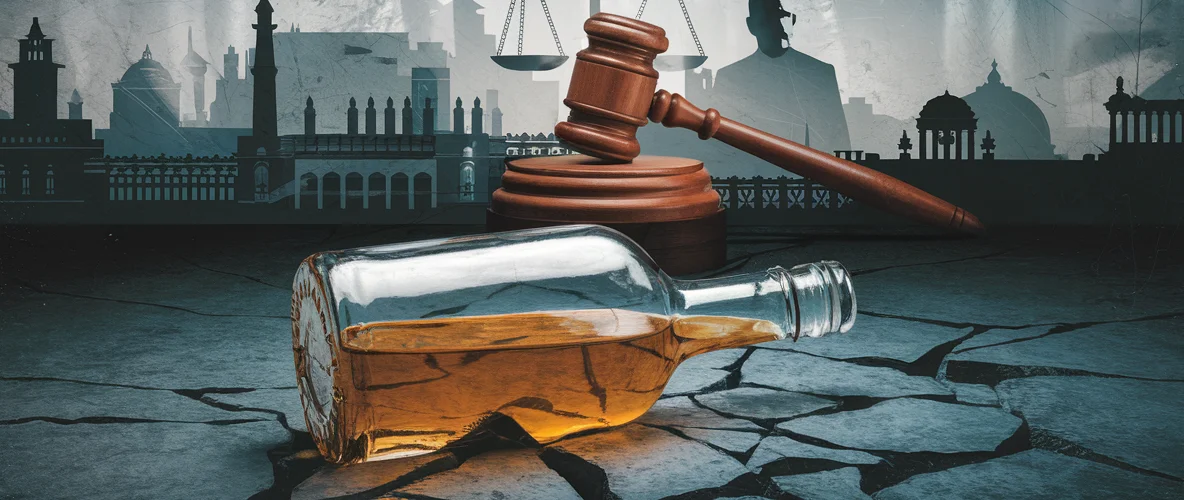
The Delhi liquor policy case has emerged as one of the most contentious political scandals in recent years, casting a long shadow over the Aam Aadmi Party (AAP) government in the national capital. This complex case, involving allegations of corruption, money laundering, and policy manipulation, has ensnared several high-profile AAP leaders, including Delhi Chief Minister Arvind Kejriwal. Let’s delve into the intricacies of this case, examining its origins, key players, and potential implications.
Origins of the Controversy
The controversy stems from the Delhi Excise Policy 2021-22, introduced by the AAP government with the stated aim of reforming the city’s liquor trade. The policy, implemented in November 2021, sought to privatize liquor sales, increase government revenue, improve the consumer experience, and eradicate the liquor mafia. Key features included shutting down government-run liquor outlets, allowing private players to open stores, and exiting the retail liquor business entirely
However, the policy soon came under scrutiny. Opposition parties, particularly the Bharatiya Janata Party (BJP), alleged that the policy was designed to benefit certain liquor traders in exchange for kickbacks to AAP leaders and was marred by procedural irregularities. Following mounting pressure and a recommendation from Lieutenant Governor V.K. Saxena, the policy was withdrawn in July 2022, barely eight months after its implementation.
Key Figures Implicated
- Arvind Kejriwal, Chief Minister: As the head of the Delhi government, Kejriwal finds himself at the center of the storm. While he hasn’t been formally charged, he has been questioned by the Central Bureau of Investigation (CBI) and the Enforcement Directorate (ED). Allegations against him include direct involvement in policy formulation, receiving kickbacks, and using the ill-gotten money for election campaigns. Kejriwal has vehemently denied all accusations, terming them politically motivated and aimed at destabilizing his government.
- Manish Sisodia, Former Deputy Chief Minister: Sisodia, who also held the excise portfolio when the policy was introduced, was arrested in February 2023. He is accused of playing a key role in formulating and implementing the controversial policy, favoring certain dealers, and receiving kickbacks. His arrest marked a significant escalation in the case, given his stature as Kejriwal’s right-hand man and the face of Delhi’s education reforms.
- Satyendar Jain, Former Health Minister: Already in jail since May 2022 on separate money laundering charges, Jain has been questioned regarding the liquor policy case. While his direct involvement in the excise policy is less clear, investigators suspect his role in the larger financial operations of the party.
- Raghav Chadha, Rajya Sabha MP: Though not directly accused in the case, Chadha has been a vocal defender of the party and its policies. He has criticized the investigation as a witch hunt and has been instrumental in shaping the AAP’s public response to the allegations.
- Sanjay Singh, Rajya Sabha MP: Singh was arrested in October 2023 in connection with the case. The ED alleges that he played a crucial role in the policy’s formulation and implementation, and in the movement of kickback money. Singh has denied all allegations, claiming political vendetta.
Investigation and Allegations
The investigation, primarily led by the CBI and ED, has focused on several key allegations:
- Policy Manipulation: The agencies allege that the policy was tailored to benefit specific liquor traders who, in turn, provided kickbacks to AAP leaders.
- South Group Connection: Investigators claim the involvement of a “South Group,” allegedly comprising YSR Congress MP Magunta Srinivasulu Reddy, his son Raghav Magunta, Telangana CM K Chandrasekhar Rao’s daughter K Kavitha, and Aurobindo Pharma’s P Sarath Chandra Reddy. This group allegedly paid Rs 100 crore to AAP leaders through Vijay Nair, the party’s communication in-charge.
- Backdating of Approvals: There are allegations that approvals for the policy were backdated to provide undue advantage to certain traders.
- Waiver of Rs 144.36 crore: The agencies claim that a waiver on liquor license fees, instituted due to COVID-19 related closures, was granted to benefit specific traders.
- Money Laundering: The ED has alleged that the kickbacks received were used for AAP’s election campaigns, particularly in Goa.
AAP’s Defense and Political Implications
The Aam Aadmi Party has consistently denied all allegations, framing the investigation as political vendetta by the BJP-led central government. They argue that:
- The policy was designed to increase government revenue and eliminate the liquor mafia.
- All decisions were taken collectively by the Delhi cabinet and with proper approvals.
- The investigation is an attempt to destabilize the Delhi government and tarnish AAP’s growing national image.
The case has had significant political implications:
- Impact on AAP’s National Ambitions: The scandal has dented AAP’s image as a party of change and anti-corruption, potentially affecting its national expansion plans.
- Leadership Crisis: With key leaders either arrested or under investigation, the party faces a leadership vacuum in Delhi.
- Centre-State Relations: The case has further strained the already tense relationship between the AAP-led Delhi government and the BJP-led central government.
- Electoral Impact: The scandal could influence voter perception in future elections, both in Delhi and in states where AAP is trying to expand its footprint.
Procedural and Legal Complexities
The case has also highlighted the complex relationship between Delhi’s elected government and the central government. The involvement of central agencies like the CBI and ED in a matter concerning the Delhi government has reignited debates about the capital’s unique administrative structure and the extent of the state government’s powers.
Moreover, the case has raised questions about the investigation process itself. AAP leaders have alleged that the agencies are being used as political tools, pointing to the timing of arrests and the prolonged detention of key figures without trial.
Conclusion
The Delhi liquor policy case remains a developing story with far-reaching implications for both the Aam Aadmi Party and the broader political landscape of India. As the investigation continues and more details emerge, it has the potential to reshape Delhi’s political dynamics and influence the national perception of AAP as a political force.
The case underscores the complex interplay between policy-making, politics, and anti-corruption efforts in India. It also highlights the challenges of governing a unique city-state like Delhi, where jurisdictional overlaps between state and central authorities often lead to political and administrative conflicts.
As the legal process unfolds, the case will likely continue to be a focal point of national political discourse, potentially influencing future policy decisions, electoral outcomes, and the trajectory of one of India’s most prominent regional parties.